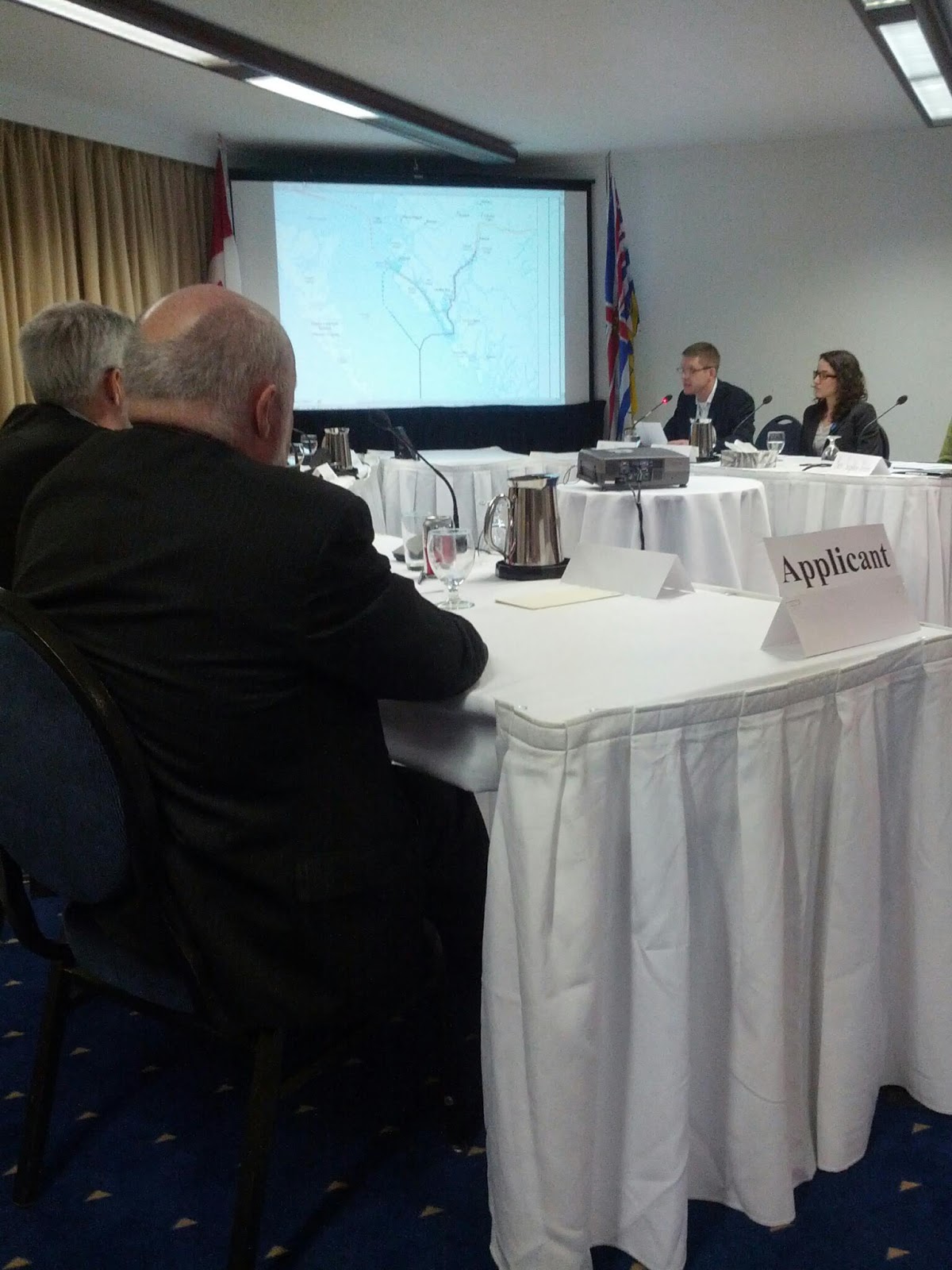
Watch "JRP process hearings -Jan 15, 2013" on YouTube
.... I shall let the video and photos speak on their own.
Tuesday, January 15, 2013
Sharing my story.
Labels:
coast,
defend our coast,
enbridge,
no tankers,
northern gateway,
oppose,
pipeline opposition
Monday, December 24, 2012
'Tis The Season...to continue to be zero waste!
Furoshiki and other such things make this Christmas a wonderful thing.
Love being able to wrap something with cloth and wanted to share what our Christmas tree looks like sans wrapped gifts... it's a beautiful sight, especially knowing that on Christmas morning - we won't have that infamous black garbage bag with mounds of paper, plastic, ribbon, bows, tape, and other such items one uses for gifts *shudder* - those cloths will either be returned to their home in the house, or simply folded, and saved for the next gift to give.... consistent with last year, nothing shall going to the landfill in my family! :)
Two of my cloths were purchased from The Soap Dispensary; I got a few others from this awesome store on Granville Island, Maiwa, (highly recommend checking it out!) they sell a plethora of amazing items but specifically, beautiful fabrics, with such beautiful patterns which you can buy by the meter (about $15/meter) - what's extra special about the fabrics is that they are organic cotton and the dyes used to make these beautiful fabrics are hand dyed with all natural dyes - all around a great shop and ethic to support. I think typically one would get the fabric and sew the ends so it doesn't fray, but I don't really know how to sew very well (yet! - it's a goal of mine) so I just left it as is - seemed to work just fine.
The rest (since I didn't have enough cloths - and actually I recommend this method FIRST :) because chances are we all have more lying around the house to re-use for a period of time, then go back to it's other function) was simply using re-usable bags, pillow cases, even an old flag (that had been ripped from being outside for so long, and was just sitting in the closet!)...I also used a table cloth! It was super fun looking around the house for what I could wrap some gifts in.
I've always disliked wrapping presents because I was too impatient to cut the paper straight, and fold it all nice, it felt weird wasting it...and I'd inevitably wrap it the worst way....now it's a fun, exciting event, I'd even go so far as to say a treasure hunt! Knowing that it's all going to be re-used again and again, no more waste, a great feeling!
I was going to try to do the whole "to and from" in my head, but then I started getting confused, so I ended up just cutting up little squares from a cereal box, that I found in the recycling bin, and writing on those, and then placing them within the fabric so they'd stay - no tape! :) I've also, in the past, just cut a little hole in it, and then tied a string around it - or hair elastic - something that was already in existence in my house. Another great item is old business cards! We tend to have SO many of those lying around - a great use for them instead of just recycling them all at once.
Of course, giving experiences as gifts, or donations to charities, or your own time, instead of tangible items mean even less waste - and that was part of my goal, as well! What are some of the things YOU do?? I'd love to hear them!
Merry and Meowy Christmas! Joyeux Noel! Feliz Natal!
Love being able to wrap something with cloth and wanted to share what our Christmas tree looks like sans wrapped gifts... it's a beautiful sight, especially knowing that on Christmas morning - we won't have that infamous black garbage bag with mounds of paper, plastic, ribbon, bows, tape, and other such items one uses for gifts *shudder* - those cloths will either be returned to their home in the house, or simply folded, and saved for the next gift to give.... consistent with last year, nothing shall going to the landfill in my family! :)
Two of my cloths were purchased from The Soap Dispensary; I got a few others from this awesome store on Granville Island, Maiwa, (highly recommend checking it out!) they sell a plethora of amazing items but specifically, beautiful fabrics, with such beautiful patterns which you can buy by the meter (about $15/meter) - what's extra special about the fabrics is that they are organic cotton and the dyes used to make these beautiful fabrics are hand dyed with all natural dyes - all around a great shop and ethic to support. I think typically one would get the fabric and sew the ends so it doesn't fray, but I don't really know how to sew very well (yet! - it's a goal of mine) so I just left it as is - seemed to work just fine.
The rest (since I didn't have enough cloths - and actually I recommend this method FIRST :) because chances are we all have more lying around the house to re-use for a period of time, then go back to it's other function) was simply using re-usable bags, pillow cases, even an old flag (that had been ripped from being outside for so long, and was just sitting in the closet!)...I also used a table cloth! It was super fun looking around the house for what I could wrap some gifts in.
I've always disliked wrapping presents because I was too impatient to cut the paper straight, and fold it all nice, it felt weird wasting it...and I'd inevitably wrap it the worst way....now it's a fun, exciting event, I'd even go so far as to say a treasure hunt! Knowing that it's all going to be re-used again and again, no more waste, a great feeling!
I was going to try to do the whole "to and from" in my head, but then I started getting confused, so I ended up just cutting up little squares from a cereal box, that I found in the recycling bin, and writing on those, and then placing them within the fabric so they'd stay - no tape! :) I've also, in the past, just cut a little hole in it, and then tied a string around it - or hair elastic - something that was already in existence in my house. Another great item is old business cards! We tend to have SO many of those lying around - a great use for them instead of just recycling them all at once.
Of course, giving experiences as gifts, or donations to charities, or your own time, instead of tangible items mean even less waste - and that was part of my goal, as well! What are some of the things YOU do?? I'd love to hear them!
![]() |
| Boo likes it! :) Zero-Waste Kitty! |
Merry and Meowy Christmas! Joyeux Noel! Feliz Natal!
Thursday, July 12, 2012
Plastic Free, Despite the Heat
It has been tremendously warm in Saskatoon, recently, and despite my quest to live without waste, and avoid plastic - I was still able to enjoy a timeless classic, the Slurpee. Plus, it tasted even better knowing I created absolutely ZERO waste from my acquisition (and maybe even sparked some interest at the till, and for those who saw what I was drinking).
The slurpee was halfway through by the time I got home, but you get the gist - brought my own re-usable mug, and my new stainless steel draw, obtained from my favourite store in Saskatoon - The Better Good .
The straw had a bit of a metal taste depending on where it touched my tongue - which I did not expect since I love drinking water from my stainless steel water bottle - so it's quite curious.... I shall have to test out the glass straws, too - perhaps I would prefer.
Either way, I'll take a bit of metal to the taste, or learn to drink properly from the straw to avoid such sensations, to save some plastic from the stomachs of the baby albatross on Midway Island.
What sorts of things have you done? Please share!
This one isn't really related to summer as one acquires bread at any point during the year, but I really love this bag that was gifted to me - and I wanted to share the glory if I have not already....
I buy about a loaf of bread each week; if not more - alone then, and just considering bread bags - in one year I will have saved 52 bags; + 52 plastic bread tags or twist-ties. Imagine how much can be saved the more people start doing this? I'm not entirely sure where this came from but I found it online, here.
Most people ask about keeping it fresh - and if this bag suffices. I have toast each morning, so I actually freeze my bread in this bag and it's just fine! For long-term storage I'd suggest freezing it in a container; and if you like it fresh, you can transfer it to a container that would be more air tight, I've also heard of some people putting it in those cake holders that sit on peoples counters (not sure the term for those)...either way - it can be made to work and it's extremely worth it - no more dealing with pesky plastic bread bags!
Saturday, June 30, 2012
Please sign! Let's keep our parks and green spaces free of harmful toxins!
I recently returned home to Calgary for a visit, and was welcomed with warning signs about herbicide application in my neighboorhood.
I was so happy to be back home, but seeing that just broke my heart and a feeling of apprehension ensued. I was looking forward to gong for a run, being outside, and enjoying the warm summer air...and now all I can think about is the toxins I'll be inhaleing, and ingesting, and all those innocent, unknowing kids playing around in the grass - a very natural thing to do!
Whether you live in right in Strathcona, Calgary, or elsewhere, a ban on pesticides, herbicides, fungicides, and all other "cides", will keep our world healthy, clean, and safe for all to enjoy.
Please sign the petition I have started, and help make this ban a reality! We all deserve clean parks and play areas for ourselves, our children, and our animals to enjoy.
Please click here:
http://www.change.org/petitions/city-of-calgary-ward-6-alderman-richard-pootmans-ban-the-application-pesticides-and-herbicides-in-strathcona-community
With tremendous gratitude, I thank you.
Monday, June 25, 2012
A Tremendously Important Read
I've recently been reminded of one of my most influential reads - if not the most. It's a quick read too, and very hand to just reference to later, or as you make your journey to reduce the toxins in your life.....the book;
Slow Death by Rubber Duck by Rick Smith & Bruce Lourie
...which I see has now been translated into French, Polish, Sweedish, and Korean. I quite like the french title "Vilain petit canard".
I highly recommend this to everyone it's absolutely perplexing to me, the amount of items we interact with that have a negative effect on our health, and yet they are continually shelved, and people continually buy them, without concern - largely because they just don't know!
However, don't be scared away by the title, and by what you don't know - knowing is better than avoidance, and this book does a great way of teaching, without having you feel completely stressed and overwhelmed.
This is a informative book, that gives you bulleted lists at the end of each chapter, to help you recap and choose your next steps, and providing healthy alternatives, along with tips and tricks along the way (ingredients and/or items to look out for, and avoid etc). It's basically the two authors, who test their blood at the beginning, and each chapter they expose themselves to an everyday item - cooking with Teflon pans, shaving their face with face cream and using shampoos - all very typical items you or I would come into contact with - they then test their blood after, among other things - very very interesting!
Please find it at your library or used bookstore (to continue with your zero-waste lifestyle), or buy it new (and then share it with others!), and have a read!
It's so important for people to read this and understand how our bodies, specifically our skin, absorb everything we put on them, and how little is done by those who are suppose to be looking out for us, to actually make products on the market safe for our use... it's the old...until you prove it's for sure not safe, well keep it on the market, even if there is reason to believe its not.... Why should you have to prove it is not safe before taking it off, what happened to making sure it is absolutely safe before putting it on the market in the first place!! As a result - we all need to take responsibility, and be more aware of what we use each day!
Be aware of what you buy, make the right decisions, and live toxin free! (and believe me, there are many alternatives, it's not like you have to just give up everything you enjoy in life - plus, as you start to learn more about the stuff you once enjoyed, you'll realize that your preferences tend to shift - but it's okay, change is good, it's healthy!)
We are the ones with the power, because we are the one with the money buying the products! We need to be aware and responsible, because no one else is looking out for our health but us - and to be honest, I trust myself more to know what's good for my body, than any large corporation - even if they do have my best interest at heart - we are all such different beings, different products will effect each of us very differently - know yourself, know your body!
Your body is a sacred place, what you use on it should be, too.
Side Note: I posted something simliar on FB but realizing that there are many individuals who are not on facebook, I thought it was important to do both - in the mean time, I'm trying to decide how best to address that issue - because most of my posts are on facebook - as such, please add me as a friend on there if you wish to see more frequent information! I will try to keep both updated though, facebook usually is the quicker, more effective medium - both have their pros)
Jocelynn NoEnbridge Rodrigues (I do believe I am searchable, if not let me know! - leave me a comment and I can add you, too!) THANKS for taking an interest and caring for our earth :)
Slow Death by Rubber Duck by Rick Smith & Bruce Lourie
...which I see has now been translated into French, Polish, Sweedish, and Korean. I quite like the french title "Vilain petit canard".
I read this in 2010 when I came back from travelling, before moving to Vancouver, it was definitely the book that changed the way I think about my everyday life and what I was using, putting on my skin, interacting with.
I highly recommend this to everyone it's absolutely perplexing to me, the amount of items we interact with that have a negative effect on our health, and yet they are continually shelved, and people continually buy them, without concern - largely because they just don't know!
However, don't be scared away by the title, and by what you don't know - knowing is better than avoidance, and this book does a great way of teaching, without having you feel completely stressed and overwhelmed.
This is a informative book, that gives you bulleted lists at the end of each chapter, to help you recap and choose your next steps, and providing healthy alternatives, along with tips and tricks along the way (ingredients and/or items to look out for, and avoid etc). It's basically the two authors, who test their blood at the beginning, and each chapter they expose themselves to an everyday item - cooking with Teflon pans, shaving their face with face cream and using shampoos - all very typical items you or I would come into contact with - they then test their blood after, among other things - very very interesting!
Please find it at your library or used bookstore (to continue with your zero-waste lifestyle), or buy it new (and then share it with others!), and have a read!
It's so important for people to read this and understand how our bodies, specifically our skin, absorb everything we put on them, and how little is done by those who are suppose to be looking out for us, to actually make products on the market safe for our use... it's the old...until you prove it's for sure not safe, well keep it on the market, even if there is reason to believe its not.... Why should you have to prove it is not safe before taking it off, what happened to making sure it is absolutely safe before putting it on the market in the first place!! As a result - we all need to take responsibility, and be more aware of what we use each day!
Be aware of what you buy, make the right decisions, and live toxin free! (and believe me, there are many alternatives, it's not like you have to just give up everything you enjoy in life - plus, as you start to learn more about the stuff you once enjoyed, you'll realize that your preferences tend to shift - but it's okay, change is good, it's healthy!)
We are the ones with the power, because we are the one with the money buying the products! We need to be aware and responsible, because no one else is looking out for our health but us - and to be honest, I trust myself more to know what's good for my body, than any large corporation - even if they do have my best interest at heart - we are all such different beings, different products will effect each of us very differently - know yourself, know your body!
Your body is a sacred place, what you use on it should be, too.
Side Note: I posted something simliar on FB but realizing that there are many individuals who are not on facebook, I thought it was important to do both - in the mean time, I'm trying to decide how best to address that issue - because most of my posts are on facebook - as such, please add me as a friend on there if you wish to see more frequent information! I will try to keep both updated though, facebook usually is the quicker, more effective medium - both have their pros)
Jocelynn NoEnbridge Rodrigues (I do believe I am searchable, if not let me know! - leave me a comment and I can add you, too!) THANKS for taking an interest and caring for our earth :)
Tuesday, May 22, 2012
There is hope, things will change, I do believe.
I wrote an article to be distributed to those at my work, to the Vancouver, and Victoria offices, that came out as part of the Quarterly Green Newsletter we, as a green team, send out - however, I felt this was applicable to not just staff at my work, but everyone - and thus, I'm sharing it here, too. :) There were photos, and it was snazzier but the words shall suffice, I hope. :) *Note: the images were obtained from the internet via google search*
That Feeling
Surely we have all seen, or read, the news, we have all been bombarded by green this, and green that – so much so that we have likely just shut off our receptors to anything with the prefix “enviro”.
So, let us take a step back, and a deep breath. What is truly going on here? I think we are past the point of debating whether humans are having an impact on the world around us. That much, we know is true. The question then becomes – do we do something about it? Or do we just sit back and pretend like nothing is wrong? If we do act, is there even a point? With 7 billion people on this world, it’s easy to feel a little insignificant.
Putting all that aside, for the moment, I think the more pressing issue is that we’ve lost our connection; to each other, to nature, and to life itself.

A lot of people ask me how I got into all of this and why I care so much, I truly wish I had the perfect answer for them, perhaps they would follow suit. However, it’s not really about any one reason, by one individual – for there cannot be one universal reason for why anybody does anything. What I have come to realize is that it’s less about a reason, or any one specific issue, and more about a feeling; that feeling of connectedness, enabling you to feel personally attached and responsible to your impacts, your neighbor’s impacts, and the world around you.
It is at this point when, the extinction of a species, or the devastation of a forest, now means something to you, because you realize that you are connected to those animals, and that forest, and if it is a loss for them, it is a loss for you, too. You feel it in your heart, deep within you. Charles Eisenstein refers to this as a shift in consciousness, when the heart becomes present. The heart is a very important variable in our sustainability journey, you see.
My one hope is that this feeling can be re-ignited in all of you. As it resides in all of you, it always has, albeit potentially hiding under some other emotions whose perceived importance took precedence over the deeper meaning and understanding to why we are all here, but, it’s there. Once we find that feeling, we realize that a profound transformation takes place. And, it is within that transformation where we realize that these “environmental actions” (for lack of a better word), we’ve either been told to do, or feel we ought to do, no longer become chores, or guilt-ridden tasks, they become habits, habits to which you, then, cannot fathom straying from. For, if you did, it would simply feel wrong, fundamentally, deep within you.
Shall we find that feeling?
How did we get to this point?
We were not always like this, you know – careless and destructive - which means we do not have to continue to be like this. It is certainly not innate to destroy beauty, pollute our living areas, and limit our ability to enjoy these natural, pristine areas. It is just that, for so long, we have had such conflicting mentalities, and inconsistent goals. For the most part, we have been told to focus on growth, especially after World War II. And, since then, we have continued on this path of continuous growth, rarely taking moments to reflect on whether this was still the right path for us; all the while slowly chipping away at what makes us human, and what we need to survive.
“We must keep growing” we are told, but why? In hopes of reaching that point where we can all live happily, care free, with enough money, and ample leisure time? Will that point ever be reached? We are busier now than we ever have been, despite all the technological advancements that are supposed to make our lives easier. What a conundrum!
Despite our knowledge that we cannot grow infinitely on a finite planet with finite resources, we seem to keep on going and growing, assuming that it will eventually work out, no time for questions. Why? What for; and, more importantly, at what cost?
Nature’s Gift
Nature has given us everything – no matter what religious, political, socio-economic beliefs you hold, you would not be living if it were not for nature and all its gifts. If the trees were not able to provide oxygen for our intake, we would cease to exist. In fact, everything that makes us human, and helps us live is derived from nature, in some form or another. Should not we work to restore that, and ensure its prolonged use so we, as humans, may continue to thrive?
Nature has been giving us numerous warning signs and it is about time we listen, if not for her, for us, for our own personal wellbeing and sanity. Nature does not need us at all, however we absolutely need nature to live, there is no room for debate in that. We need clean air and clean water – that is a biological fact. As Jesse Lemieux, founder of Pacific Permaculture, noted, in his recent talk Healthy Soil= Healthy Veggies = Healthy You, "Nature and life will always be here. What we face now is how we will choose to participate in that. Will we continue to work against nature or work with it to support and restore function in living systems and thus our own societies; building time, and lasting wealth, in healthy soil and non-discriminatory biodiversity?”
Warning Signs
Take a look at the albatross on Midway Island, as Chris Jordan puts it “On one of the remotest islands on our planet, tens of thousands of baby albatrosses lie dead on the ground, their bodies filled with plastic from the Pacific Garbage Patch”.
Is it fair that due to our insatiable need for stuff, and our ever pressed-for-time-lifestyles where convenience is a requirement, we have managed to put a perfectly innocent population of birds at risk of extinction?
Is it right that because of our care-free disposable life-style, we are compromising the lives of millions of sea and land creatures? Or, as Captain Charles More describes, “feminizing the waters, and tricking fish into eating plastic (which ultimately ends up in our stomachs) disrupting every aspect of their lives (and ours by default) and their precious ecosystems?” (Hear more about his talk at UBC here).
Is it right that far away, on the south east cost of Hawaii, at Kamilo Beach, mounds of plastic continually wash-up on shore, despite the locals’ best efforts to clean it up?
Is it right that due to our unsustainable, chemically induced agricultural process, where pesticide use runs rampant, we are seeing millions upon millions of honey bees dying? What has now been classified as, Colony Collapse Disorder (“CCD”). Though a strong indication of our misgivings as responsible humans, this is about more than a few bees dying. Lest we forget, everything we eat, essentially our livelihood depends on bees for fertilization. Are we willing to give that up, for crops which are genetically produced in a lab?
The list goes on and I ask myself, is this nature we intended? Is this the world we want to live in?
The Outcomes
We are literally changing the way all species act – and not for the better. The direct consequences are plentiful, and yet we remain paralyzed, either with doubt, ignorance, fear, or helplessness. Worse, are the indirect consequences which flow all throughout the food-chain, affecting all species. Bio magnification is a huge problem, and one that is, in the grand scheme of things, a relatively new concept. A great example of this is in women’s breast milk, wherein some women have been told to refrain from giving their babies milk as all the harsh toxins in the woman’s body are being concentrated in that area – from all the make-up, hair products, creams, gels, and pesticides ridden fruit we unknowingly ingest.
We are all connected, even if the issues seem far away – on gyres in the middle of the Pacific Ocean – we are all connected. We are all a part of this.
In short, our environment has limits, and we are at a point in time where we are breaking those limits (as we all know) – we have heard it so many times that it’s become the norm and we just smile and nod, and continue as usual when we hear it. Frighteningly enough, we’ve accepted that we are messing up the planet, but we keep on, business as usual. Why? I urge you to reflect, and challenge the initial, hurried, response of dismissal.
In our race to the top we have veered so far away from that which makes us human, indeed, that which flourishes our survival – community – that sense of connectedness. We are not individualistic beings – though our current economic system would have us believe we are. We are social beings, and we need community – time with family and friends. We yearn to feel that sense of connectedness to others, and to the earth, whether we are aware of this or not and we truly benefit from these ties. We may notice it when we hang out with friend; we just feel good, or when someone is lost, and they ask you for help; we want to help them out, and we feel great doing it.
What can we do?
When you are feeling hopeless and overwhelmed, remember those around you, those who bring you joy, laughter, and love. After-all, what is life for? Remember that anything you can do, no matter how minute it seems, does have an impact – never give up hope.
When you are feeling perplexed and paralyzed from the bombardment of environmental impacts and consequences, you are not sure how to move forward, and you feel like your actions are insignificant, remember that you can make a difference, and there are people who care, too. You are not in this alone, and you’ll always have your network of people to help you out.
Remember that, we all benefit when those around us benefit and when nature benefits – as we are, in essence, nature, too. And, when you are faced with a decision and you are not quite sure the best choice, remember the quote by Scott Nearing, “Do the best that you can, in the place where you are, and be kind”.
We must not forget how perfectly precious this world we exist in truly is, and we must remember that it is okay to feel. Feelings are what make us human, and what ultimately evoke action. Let us not be afraid to feel, and let us not be afraid to act, we are here, now, and life is a gift. Let us start living in a way that reflects this – after all, it is in your own best interest, too.
Consider the quote from the astronaut, Rusty Schweickart, seeing it from so far as a pale blue dot really changes ones perspective:
From the moon, the Earth is so small and so fragile, and such a precious little spot in that Universe, that you can block it out with your thumb. Then you realize that on that spot, that little blue and white thing, is everything that means anything to you -- all of history and music and poetry and art and death and birth and love, tears, joy, games, all of it right there on that little spot that you can cover with your thumb. And you realize from that perspective that you've changed forever, that there is something new there, that the relationship is no longer what it was.
Surely we have all seen, or read, the news, we have all been bombarded by green this, and green that – so much so that we have likely just shut off our receptors to anything with the prefix “enviro”.
So, let us take a step back, and a deep breath. What is truly going on here? I think we are past the point of debating whether humans are having an impact on the world around us. That much, we know is true. The question then becomes – do we do something about it? Or do we just sit back and pretend like nothing is wrong? If we do act, is there even a point? With 7 billion people on this world, it’s easy to feel a little insignificant.
Putting all that aside, for the moment, I think the more pressing issue is that we’ve lost our connection; to each other, to nature, and to life itself.

A lot of people ask me how I got into all of this and why I care so much, I truly wish I had the perfect answer for them, perhaps they would follow suit. However, it’s not really about any one reason, by one individual – for there cannot be one universal reason for why anybody does anything. What I have come to realize is that it’s less about a reason, or any one specific issue, and more about a feeling; that feeling of connectedness, enabling you to feel personally attached and responsible to your impacts, your neighbor’s impacts, and the world around you.
It is at this point when, the extinction of a species, or the devastation of a forest, now means something to you, because you realize that you are connected to those animals, and that forest, and if it is a loss for them, it is a loss for you, too. You feel it in your heart, deep within you. Charles Eisenstein refers to this as a shift in consciousness, when the heart becomes present. The heart is a very important variable in our sustainability journey, you see.
My one hope is that this feeling can be re-ignited in all of you. As it resides in all of you, it always has, albeit potentially hiding under some other emotions whose perceived importance took precedence over the deeper meaning and understanding to why we are all here, but, it’s there. Once we find that feeling, we realize that a profound transformation takes place. And, it is within that transformation where we realize that these “environmental actions” (for lack of a better word), we’ve either been told to do, or feel we ought to do, no longer become chores, or guilt-ridden tasks, they become habits, habits to which you, then, cannot fathom straying from. For, if you did, it would simply feel wrong, fundamentally, deep within you.
Shall we find that feeling?
How did we get to this point?
We were not always like this, you know – careless and destructive - which means we do not have to continue to be like this. It is certainly not innate to destroy beauty, pollute our living areas, and limit our ability to enjoy these natural, pristine areas. It is just that, for so long, we have had such conflicting mentalities, and inconsistent goals. For the most part, we have been told to focus on growth, especially after World War II. And, since then, we have continued on this path of continuous growth, rarely taking moments to reflect on whether this was still the right path for us; all the while slowly chipping away at what makes us human, and what we need to survive.
“We must keep growing” we are told, but why? In hopes of reaching that point where we can all live happily, care free, with enough money, and ample leisure time? Will that point ever be reached? We are busier now than we ever have been, despite all the technological advancements that are supposed to make our lives easier. What a conundrum!
Despite our knowledge that we cannot grow infinitely on a finite planet with finite resources, we seem to keep on going and growing, assuming that it will eventually work out, no time for questions. Why? What for; and, more importantly, at what cost?
Nature’s Gift
Nature has given us everything – no matter what religious, political, socio-economic beliefs you hold, you would not be living if it were not for nature and all its gifts. If the trees were not able to provide oxygen for our intake, we would cease to exist. In fact, everything that makes us human, and helps us live is derived from nature, in some form or another. Should not we work to restore that, and ensure its prolonged use so we, as humans, may continue to thrive?Nature has been giving us numerous warning signs and it is about time we listen, if not for her, for us, for our own personal wellbeing and sanity. Nature does not need us at all, however we absolutely need nature to live, there is no room for debate in that. We need clean air and clean water – that is a biological fact. As Jesse Lemieux, founder of Pacific Permaculture, noted, in his recent talk Healthy Soil= Healthy Veggies = Healthy You, "Nature and life will always be here. What we face now is how we will choose to participate in that. Will we continue to work against nature or work with it to support and restore function in living systems and thus our own societies; building time, and lasting wealth, in healthy soil and non-discriminatory biodiversity?”
Warning Signs
Take a look at the albatross on Midway Island, as Chris Jordan puts it “On one of the remotest islands on our planet, tens of thousands of baby albatrosses lie dead on the ground, their bodies filled with plastic from the Pacific Garbage Patch”.
Is it fair that due to our insatiable need for stuff, and our ever pressed-for-time-lifestyles where convenience is a requirement, we have managed to put a perfectly innocent population of birds at risk of extinction?
Is it right that because of our care-free disposable life-style, we are compromising the lives of millions of sea and land creatures? Or, as Captain Charles More describes, “feminizing the waters, and tricking fish into eating plastic (which ultimately ends up in our stomachs) disrupting every aspect of their lives (and ours by default) and their precious ecosystems?” (Hear more about his talk at UBC here).
Is it right that far away, on the south east cost of Hawaii, at Kamilo Beach, mounds of plastic continually wash-up on shore, despite the locals’ best efforts to clean it up?
Is it right that due to our unsustainable, chemically induced agricultural process, where pesticide use runs rampant, we are seeing millions upon millions of honey bees dying? What has now been classified as, Colony Collapse Disorder (“CCD”). Though a strong indication of our misgivings as responsible humans, this is about more than a few bees dying. Lest we forget, everything we eat, essentially our livelihood depends on bees for fertilization. Are we willing to give that up, for crops which are genetically produced in a lab?
The list goes on and I ask myself, is this nature we intended? Is this the world we want to live in?
The Outcomes
We are literally changing the way all species act – and not for the better. The direct consequences are plentiful, and yet we remain paralyzed, either with doubt, ignorance, fear, or helplessness. Worse, are the indirect consequences which flow all throughout the food-chain, affecting all species. Bio magnification is a huge problem, and one that is, in the grand scheme of things, a relatively new concept. A great example of this is in women’s breast milk, wherein some women have been told to refrain from giving their babies milk as all the harsh toxins in the woman’s body are being concentrated in that area – from all the make-up, hair products, creams, gels, and pesticides ridden fruit we unknowingly ingest.
We are all connected, even if the issues seem far away – on gyres in the middle of the Pacific Ocean – we are all connected. We are all a part of this.
In short, our environment has limits, and we are at a point in time where we are breaking those limits (as we all know) – we have heard it so many times that it’s become the norm and we just smile and nod, and continue as usual when we hear it. Frighteningly enough, we’ve accepted that we are messing up the planet, but we keep on, business as usual. Why? I urge you to reflect, and challenge the initial, hurried, response of dismissal.
In our race to the top we have veered so far away from that which makes us human, indeed, that which flourishes our survival – community – that sense of connectedness. We are not individualistic beings – though our current economic system would have us believe we are. We are social beings, and we need community – time with family and friends. We yearn to feel that sense of connectedness to others, and to the earth, whether we are aware of this or not and we truly benefit from these ties. We may notice it when we hang out with friend; we just feel good, or when someone is lost, and they ask you for help; we want to help them out, and we feel great doing it.
What can we do?
When you are feeling hopeless and overwhelmed, remember those around you, those who bring you joy, laughter, and love. After-all, what is life for? Remember that anything you can do, no matter how minute it seems, does have an impact – never give up hope.
When you are feeling perplexed and paralyzed from the bombardment of environmental impacts and consequences, you are not sure how to move forward, and you feel like your actions are insignificant, remember that you can make a difference, and there are people who care, too. You are not in this alone, and you’ll always have your network of people to help you out.
Remember that, we all benefit when those around us benefit and when nature benefits – as we are, in essence, nature, too. And, when you are faced with a decision and you are not quite sure the best choice, remember the quote by Scott Nearing, “Do the best that you can, in the place where you are, and be kind”.
We must not forget how perfectly precious this world we exist in truly is, and we must remember that it is okay to feel. Feelings are what make us human, and what ultimately evoke action. Let us not be afraid to feel, and let us not be afraid to act, we are here, now, and life is a gift. Let us start living in a way that reflects this – after all, it is in your own best interest, too.
Consider the quote from the astronaut, Rusty Schweickart, seeing it from so far as a pale blue dot really changes ones perspective:
From the moon, the Earth is so small and so fragile, and such a precious little spot in that Universe, that you can block it out with your thumb. Then you realize that on that spot, that little blue and white thing, is everything that means anything to you -- all of history and music and poetry and art and death and birth and love, tears, joy, games, all of it right there on that little spot that you can cover with your thumb. And you realize from that perspective that you've changed forever, that there is something new there, that the relationship is no longer what it was.
Sunday, January 8, 2012
When the City Bins just won’t Cut It (you may have to)
Edit: I'm moving the conclusion to the top, I think it's important - so now I suppose it would be more of an "executive summary"..... Long story short – consider what you’re coming into contact with in the first place, to avoid having to deal with it in the end, be creative and, most importantly, have some fun with it!! Show people how much fab you can create with old items that the majority of people wouldn't think twice about. Set a trend, and share with others what you've done! Go on, do it! :)"
Is it weird that I actually enjoy taking apart random items and sorting their parts into their proper “recycling” category? As I clean out my apartment and try to de-clutter and simplify my life, I realize all the random things I unintentionally accumulate – some are still in working order and I just don’t need them so I can give them away, but other things have lived their planned obsolete life and in most homes, would be in the dumpster and on the next train to the landfill. In an attempt to avoid throwing stuff out (while trying to consider everything that comes into my life that may inevitably end up in the landfill to avoid it in the first place) I get down to business. And, by that I mean – bust out my tool kit. A handy thing to have, I’ve realized, when trying to recycle those impossible-to-recycle-multi- material-glued-fused-je-ne-sais-quoi items. Or, as my new found enviro friend calls them “CHARMing items” which stands for “Crazy Hard to Recycle Materials” and it’s so very appropriate as they do tend to charm their way into each and every household. So, WATCH OUT!
With that, I decided that on my journey to split apart and dismantle random items in hopes of properly recycling them, I’d take some photos and share what I’ve learned along the way. I’m sure that many of you have these types of items in your home. It’s actually really fun, too, especially because you feel good knowing you tried your best. The series of questions, process or, hierarchy of homes is as follows (I started to make a flow chart as I thought it would be both fun and educational, but it might just be easier to have it like this :))
1. Is it really time to get “rid” of this item?
2. Do I really have no other use for this item? Google it and find out what others are doing! You’d be surprised at how many great ideas there are.
3. Could someone else benefit from this item? i.e. Can it be given away?
4. Is it just one type of material, or easy to split up? Can it be recycled with city recycling?
5. Is it toxic or has the potential to be toxic if dismantled? Take it to where facilities exists (Fire Stations usually but just Google it and don't risk harming yourself and the environment further)
6. Is it electronic, or battery powered? If yes dispose at the proper facilities – in Van that would be electronics recycling depot but a lot of other stores now are taking in old appliances and such – both private and city run here’s an example Unplugged, which London Drugs takes part in, but they now have their own take back program, too. Google is your friend in many of these questions!
Things I’ve disassembled (see photos) – electric toothbrush heads (note: only the head, the base is re-used and if it eventually breaks down, I will take it to an electronics recycling place), old pens and highlighters, toothpaste tube, make-up containers/brushes (from o-so-long ago).
| This was a sneaky highlighter with many "intricate parts" i.e. metal in obscure places. |
| This is why it's best to consider what you buy before hand - ideally something that can easily break into its parts and be recycled accordingly. |
| Metals grouped on the left (in a container that was part of a circular highlighter...so unnecessary), plastics on the right, and highlighter innards in the middle (which I wasn't entirely sure what to do with - so they were "recycled" to Urban Woodwaste) - anyone have ideas? |
| Miscellaneous, hard/rigid plastics |
![]() |
| Taking apart a rasor, and miscellaneous old make-up items (from when I was in jr. high/high school) |
![]() |
| This is one of those eyelash-on-one-side-eyebrow-on the-other-brushes - again metal within plastic that would have likely just been tossed. |
![]() |
| "The Metals" |
![]() |
| Ah yes, the infamous toothpaste tubes - has anyone ever seen what they look like inside? This was my first time. |
![]() |
| Metallic laminated plastic in more plactic :( |
![]() |
| The two plastic portions on the left was put into rigid plastics for Pacific Mobile Depot, the metally remnants were placed in my Bottle Brick. |
You’ll notice that the items I pull apart are typically the following three:
1) Miscellaneous metals: which when I see them now I have this vivid image of a mine site, and people/machines working at ravaging the earth for metals, blood, sweat and tears of both people and mother nature. Really makes me think – so many individuals worked so hard for this metal to end up in my pen that I barely use. The environment worked even harder at restoring the land and recovering from the mine site's impact. Now that it’s ended up in my toothbrush,or pen, or whatever else I have lying around, and it’s life is complete with me, it’s taken me even more work to remove it properly. So much environmental impact and energy used for one teeny tiny piece of metal that really didn’t improve my life. Note: these items if aluminum will go into the blue bin recycling, if they are scrap metal (e.g. steel - can test if it's magnetic, if yes, then steal, if no, aluminum) and they will be taken to Pacific Mobile Depot.
2) Miscellaneous hard plastic pieces: go into my “hard plastic” recycling bin and will be taken to Pacific Mobile Depot
3) Neither plastic, nor metal - I really have no clue and need to google what to do with these! Ex: inside of pens, the felt tube inside of pens/highlighters but as mentioned above - Urban Woodwaste was where these specific ones were taken. I'm still not convinced that's the best place since they do end up burning it for fuel, well, that and, I'd rather just avoid it in the first place.
Some cool ideas I found whilst searching online – in my steps before finally disassembling – were for pens – a lamp, or a name-tag holder for your garden.
....and that's just a start!
Subscribe to:
Posts (Atom)